
The Lost World
But not everything is lost...

A few days ago, my feed was drowned by this image of an ad campaign in New York.
Yet the takes remained way too superficial to grasp the depth of despair this fun campaign speaks to.
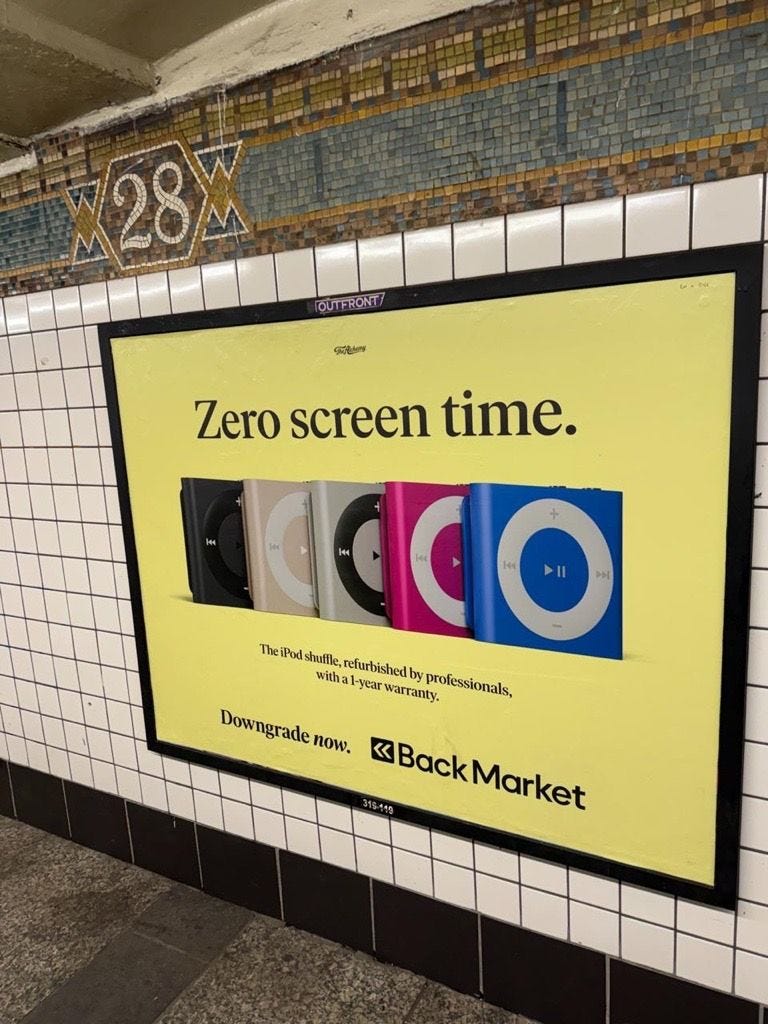
Even Tony Fadell, the American engineer, designer, and entrepreneur widely known as the “father of the iPod” and a co-creator of the iPhone, posted about it.
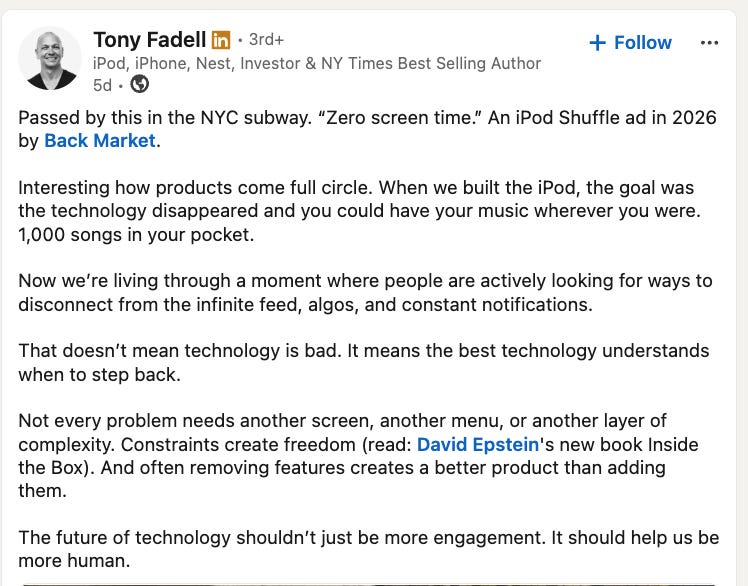
There are a few things Fadell is only half-acknowledging.
The iPod Shuffle wasn’t constrained by design but because the tech of 2005 couldn’t do more in that form factor cheaply. People are now choosing it as a constraint, which is a different thing.
The “constraints create freedom” framing has some truth to it, but it slightly launders the history.
Ironically, the iPhone, which Fadell also worked on, is the device that broke the dam and the Shuffle is now being marketed as the escape from the world that device created!
Is this perhaps another engineer seeking forgiveness?
The Back Market ad is fantastic: “Downgrade now” is the kind of line you only get when you fully understand the cultural moment. But let’z go three layers deeper.
YOUR HUMAN OVERRIDE
1) Grief with plausible deniability
I often find myself very nostalgic of the 90s-early 2000s. Nostalgia is wanting the past back. What people are responding to here is closer to mourning a version of themselves they can’t access anymore — the person who could sit with one album for an hour, who had a music taste instead of an algorithm, who finished things.
You used to be the kind of person for whom whole albums made sense. The behavior change is downstream of an identity change you didn’t consent to.
The Shuffle ad works because it briefly returns the agency, implying that the renovation is reversible, that the previous tenant is still in there somewhere.
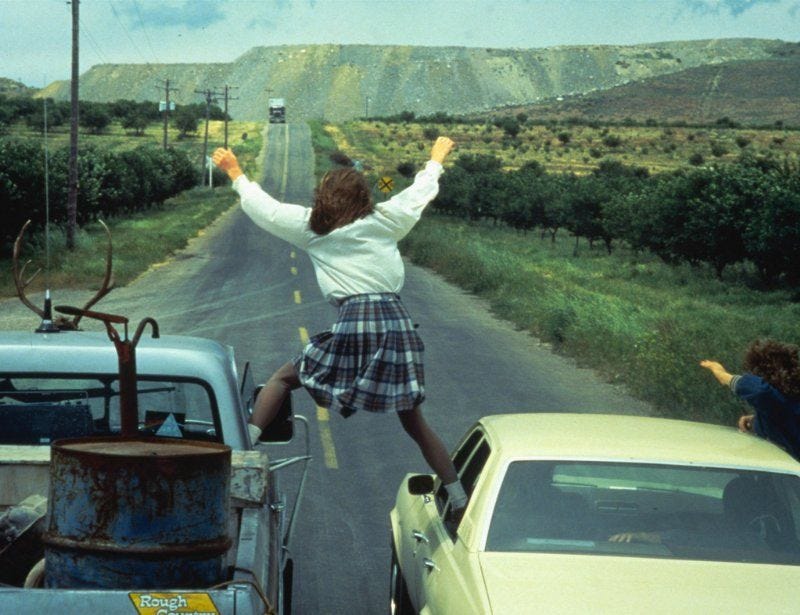
There’s also a specific kind of shame the ad neutralises. Saying “I can’t focus anymore” is a confession, it makes your willpower, your seriousness, your worth too vulnerable. Saying “I bought an iPod Shuffle” is a story about taste. One is a wound, the other is a personality.
The genius of the ad is offering a socially legible container for what is actually a private grief.
2) Finite as the luxury
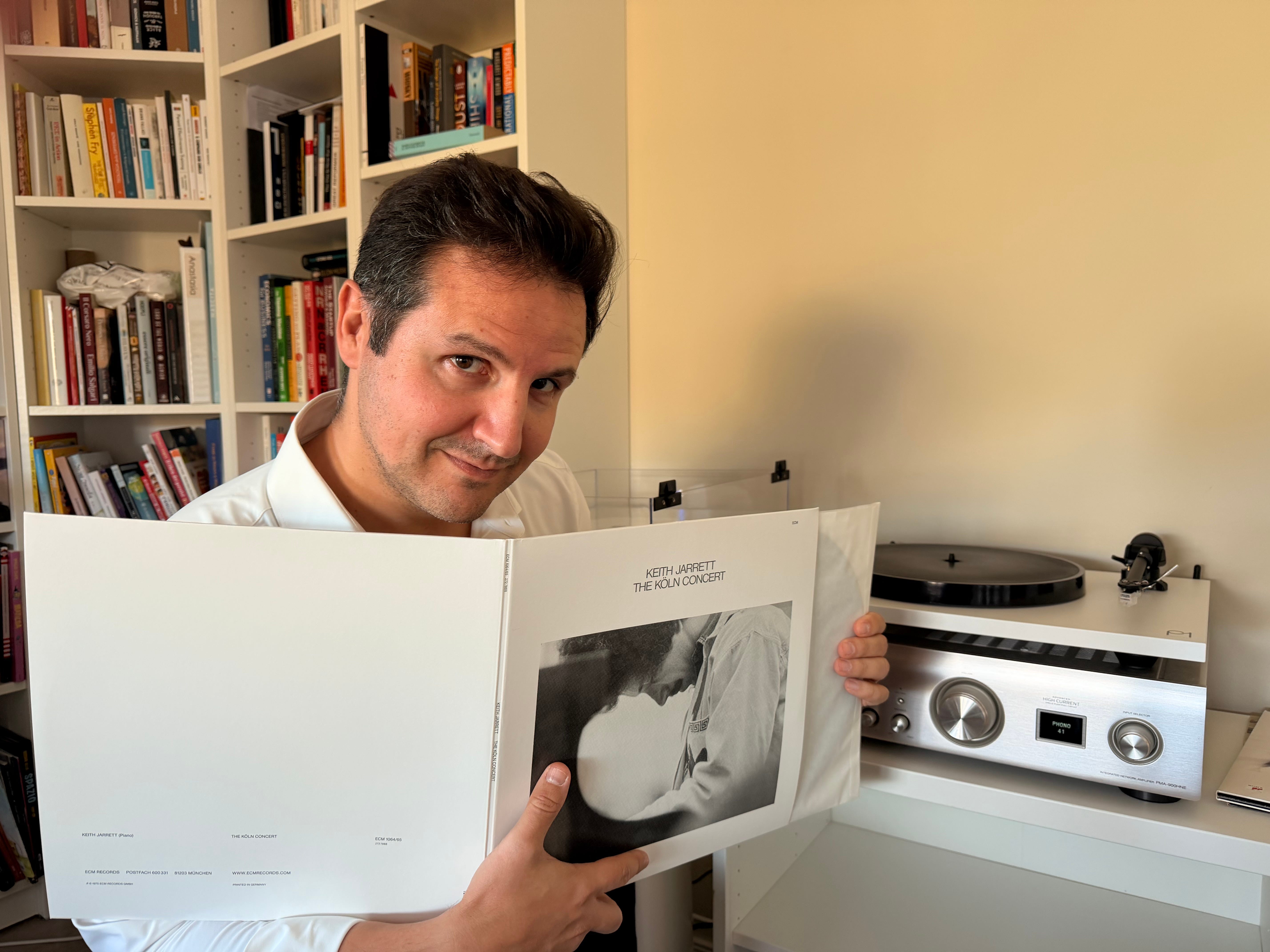
My vinyl holds half an album (or a quarter of a concert). A Shuffle holds maybe 240 songs. Spotify holds 100 million. Boy, that infinite optionality is exhausting, isn’t it?
Every Spotify session is 100 million micro-decisions you didn’t make, sitting in your peripheral vision. The cognitive overhead of not choosing the other 99,999,760 songs is real and unrelenting. A finite library gives you back mental real estate.
A constraint is the removal of a tax you didn’t know you were paying.
There’s also a status inversion happening that’s worth calling out.
For most of human history, “more” was the luxury — more food, more clothes, more access, more options. Abundance signalled wealth because abundance was scarce.
We’ve now lived through maybe twenty-five years of digital abundance being free and trivial, and the social meaning has flipped. Now “more” is what poor attention has. The new luxury good is the ability to choose less and stick with it, which requires self-knowledge (knowing what you actually want), security (not needing to keep options open), and time (the rarest currency).
Letterpress, slow food, vinyl, film cameras, the Shuffle — they’re all in the same category, and I don’t think it’s the “vintage” category. I believe it is something deeper: let’s call it legibly chosen finitude.
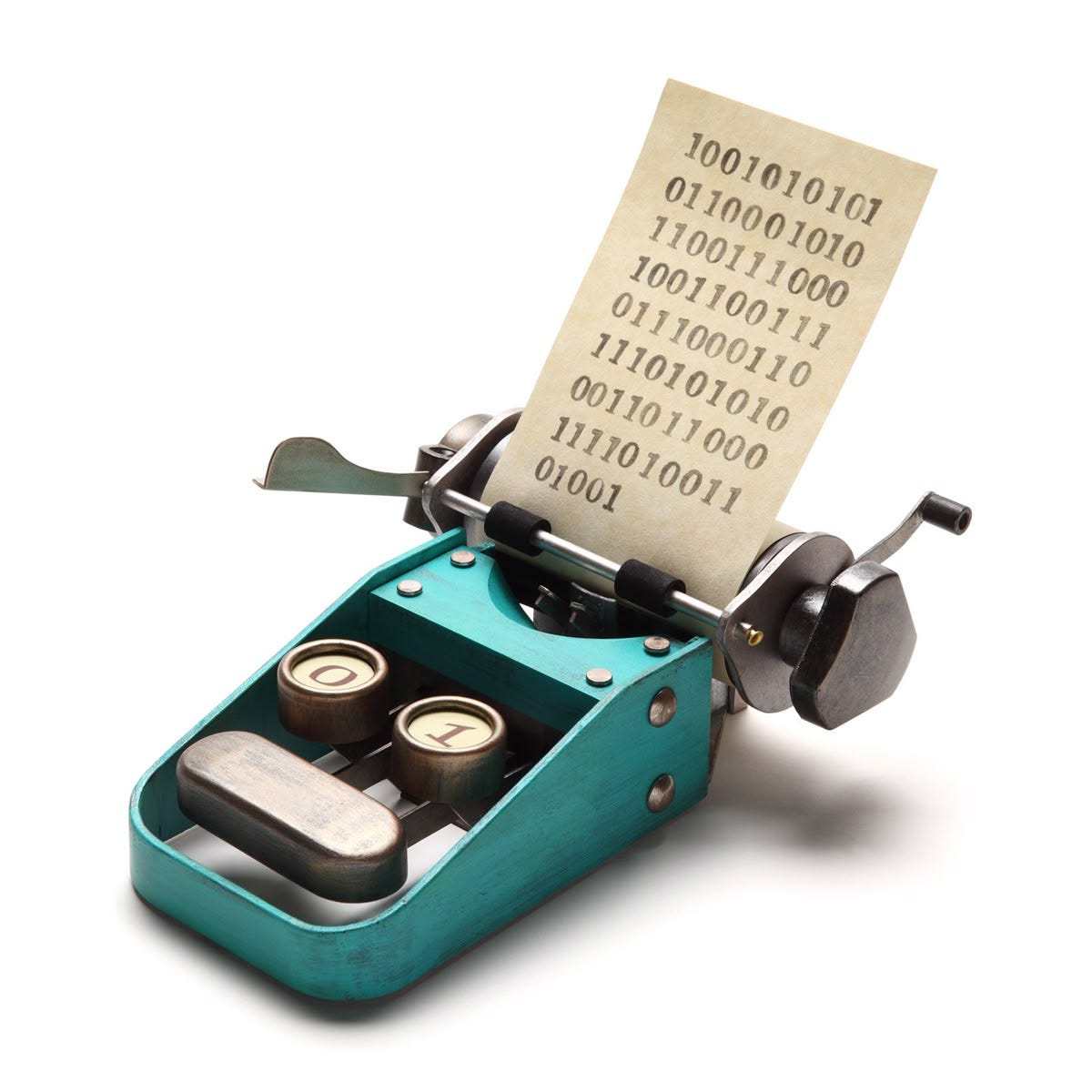
Choosing finite is how you become a person with edges again. Infinite optionality dissolves the self because the self is constituted by what it commits to and forgoes. You are your no’s as much as your yes’s. The algorithm robs you of meaningful no’s by removing the cost of yes. A finite library forces the no’s back into existence, and the no’s reassemble you into someone with shape.
3) The body wants back in (i.e., why I love vinyl)
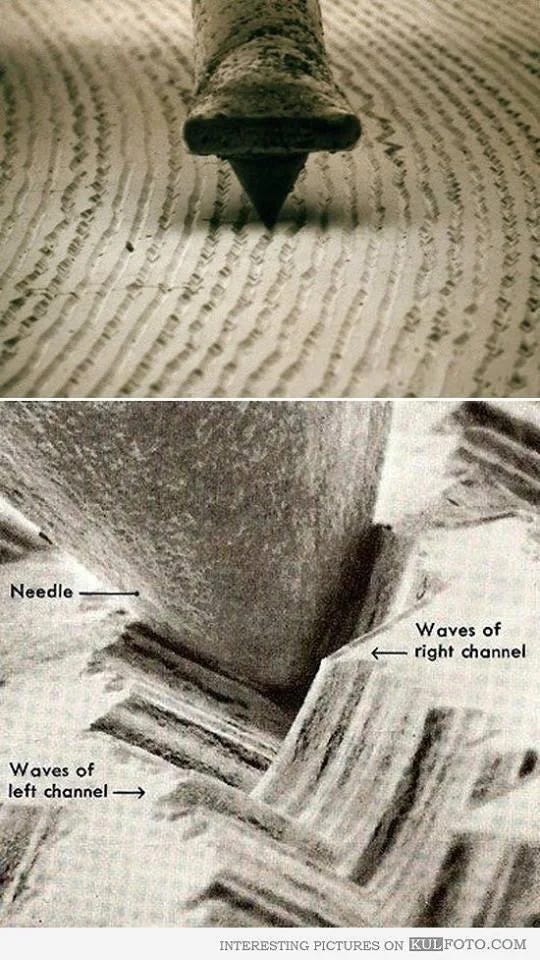
The thing screens did that almost no one noticed at the time is that they collapsed the entire spectrum of human gesture into one motion: the swipe. Reading, choosing music, navigating, shopping, talking, learning, dating, and much more became the same flick of a thumb. This is unprecedented in human history. Every previous tool required its own motion: the violin doesn’t play like a hammer doesn’t swing like a pen doesn’t write like a needle doesn’t drop. When my kids were deprived of writing with pen and paper during COVID, they lost important mental faculties and brain connections built by that gesture.
The body knew where it was by what it was doing. Screens severed that. Your body has no idea whether you’re reading Tolstoy or buying socks because the gesture is identical. Proprioceptive identity — the sense of being a body engaged with a particular task — got dissolved into uniform glass.
The Shuffle’s click wheel and physical affordances matter because they give you back a task-specific motion. Your thumb knows it’s choosing music in a way that swiping doesn’t. This sounds small. It isn’t. The motor cortex and the sense of agency are deeply linked: feeling like you did something requires the body to have actually done something distinct.
Touchscreens give you outcomes without efforts, which is why everything done on them feels slightly unreal and slightly unsatisfying even when it works. Over years, this accumulates as a low-grade dissociation from your own actions.
Memory is the other casualty no one talks about. Memory is encoded with motor and spatial context: you remember where on the page something was, you remember the weight of the book, you remember turning the record over. This is called embodied cognition. It’s how the hippocampus works. When all your inputs come through the same flat rectangle, your brain has nothing to hang them on. Hence, the strange contemporary symptom of having consumed enormous amounts of content and remembering almost none of it. It’s not your fault because you didn’t pay attention. This new setup doesn’t give your body something to attach the memory to.
The vinyl ritual — sleeve, needle, flip, sleeve — is a memory-encoding scaffold. Same with dog-earing a page, same with the click wheel’s haptic feedback.
And there’s something almost spiritual underneath this, though I’ll try to say it without being cheesy. Humans evolved as creatures whose thinking happens through doing.
The Greeks walked while they philosophised. Monks copied texts by hand because copying was a way of knowing. Cooks know things their hands know that they can’t say. The body is part of the cognitive apparatus, and it’s too often mistaken as being just a delivery (and receptive) vehicle for the brain. Fifteen years of touchscreen primacy have run a hidden experiment on whether thinking can be done with the body sidelined, and the early results are in: it can’t, or at least not well, or at least not in a way that feels like living.
People reaching for tactile objects right now are trying to think again.
This is why my wife and I started building a vinyl collection. We see it as a tool you use to be a person.
This is your best article yet!